Goldman Sachs projects global GDP growth of 2.8 percent in 2026, with the United States outperforming due to tax cuts, easier financial conditions, and a reduced drag from tariffs. As a result of these tax cuts, U.S. consumers are expected to receive roughly $100 billion in additional tax refunds in the first half of 2026, equivalent to about 0.4 percent of annual disposable income. Goldman Sachs economists also expect core inflation to moderate and policy rates to decline across developed markets in 2026. The question, however, is whether global growth under current policy frameworks will translate into widely shared prosperity, or whether it will reinforce the distortions that have come to define modern capitalism, particularly the persistent disregard for mounting debt and structural deficits.
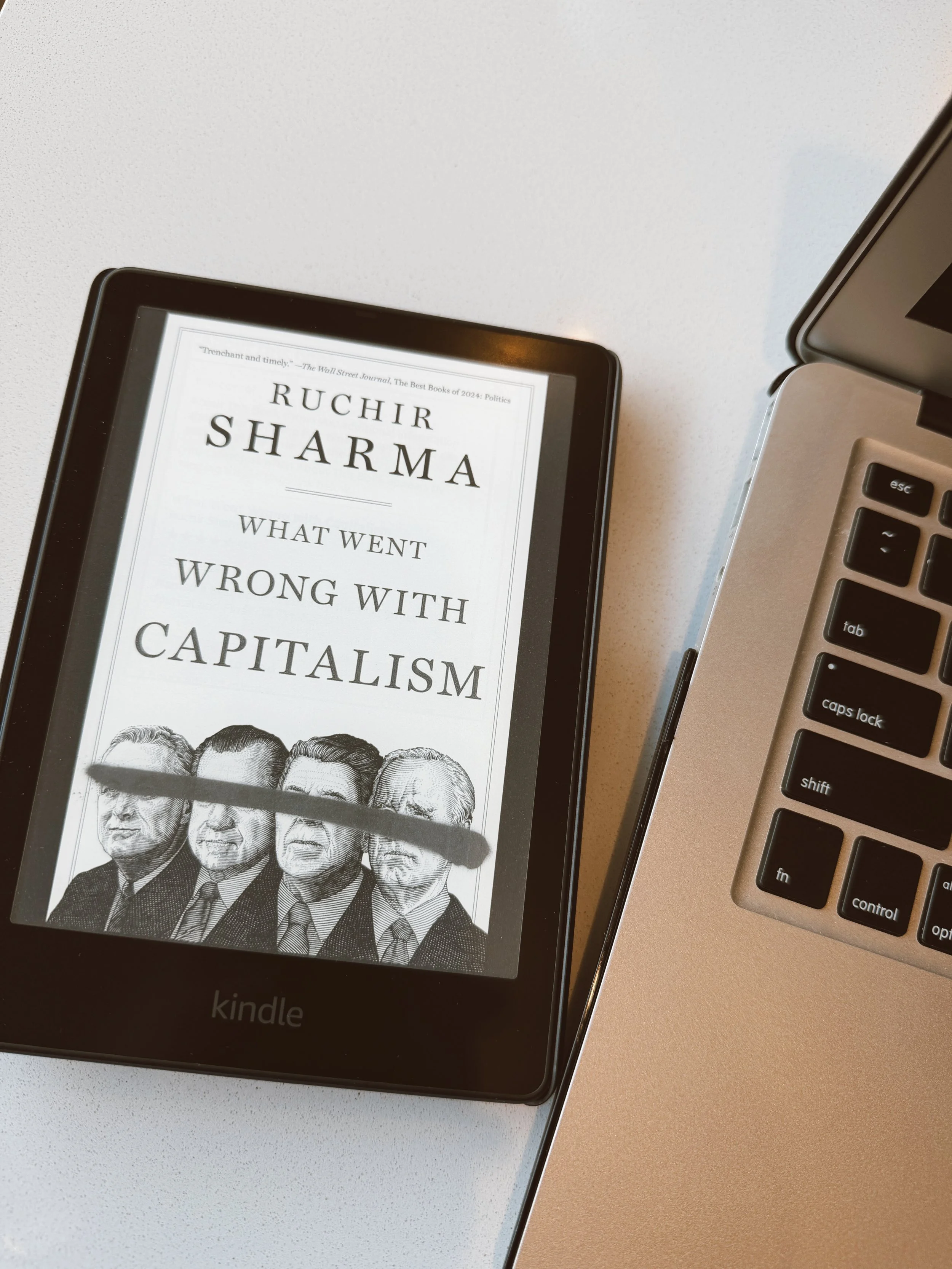
Drawing on economic crises from the 1960s through the 2000s, What Went Wrong With Capitalism by Ruchir Sharma examines strategies such as tax cuts and easier financial conditions can genuinely produce shared prosperity. Published in the aftermath of the COVID-19 pandemic, the book argues that capitalism’s dysfunction is not the result of market failure alone, but of decades of policy choices that expanded government intervention, normalized debt, encouraged easy credit, and weakened competition. Sharma identifies a set of structural problems confronting capitalist societies that increasingly shape how the global economy functions and who benefits from growth.
Government Expansion and Permanent Deficits
Part I of What Went Wrong With Capitalism retraces the economic history of the last century, showing how governments evolved from relatively limited actors before the Great Depression to omnipresent forces in the twenty-first century. Prior to the 1970s, governments in developed economies rarely ran deficits outside wartime. Since then, deficits have become structural rather than exceptional. Sharma notes that large capitalist economies began running annual deficits in the late 1970s, marking a fundamental shift in fiscal norms.
Rising debt in the 1980s further depressed growth while encouraging new borrowing by households and businesses. The resulting recoveries were characterized by weak growth and persistently low job creation. Between 2007 and 2016, easy money policies disproportionately boosted the wealth of the top 1 percent while pushing the net worth of the bottom half of Americans below zero. Sharma attributes rising inequality to two main forces: cheap credit that drove stock prices up faster than housing prices, and a housing market in which more expensive homes appreciated faster than cheaper ones throughout the 2010s. Between 1980 and 2008, the U.S. economy expanded roughly fourfold, while total debt grew more than elevenfold.
Even long after the 2008 financial crisis, the Federal Reserve remained the largest buyer in the Treasury market, often purchasing more than half of newly issued U.S. government bonds in a given month. By 2023, the Fed held roughly 22 percent of Treasuries in circulation, up from 8 percent in 2008, placing the United States on a trajectory similar to Japan, where the central bank owns more than half of outstanding government debt. According to Sharma, modern capitalism has been reshaped by governments and central banks that inject more liquidity into the economy than markets can productively absorb.
Low interest rates were initially expected, under standard economic models, to stimulate investment broadly across firms. In practice, large companies benefited disproportionately, investing more, earning higher profits, and driving equity valuations upward. Cheap money pushed investors toward equities and enabled dominant firms to further entrench their market power. When markets are free to allocate capital, they aggregate information from millions of investors into prices that guide resources toward the most productive firms and economies. Sharma argues that this mechanism has been fundamentally compromised. He also notes that conservative economists continue to argue that tax cuts alone can resolve structural economic problems, including deficits, despite mounting evidence to the contrary.
Productivity Decline
Sharma links long-term productivity growth to population expansion and globalization, forces that historically spread capitalism and raised living standards. The pandemic accelerated existing trends, directing capital toward large firms, particularly major technology companies. Before 2000, falling interest rates encouraged competition and innovation, contributing to the productivity boom of the dot-com era. As rates approached zero, however, they incentivized consolidation, allowing dominant firms to eliminate competitors and suppress productivity growth. This raises a forward-looking concern: if inflation in the United States has indeed moderated, as Goldman Sachs suggests, and the Federal Reserve cuts rates more aggressively than expected, could the economy once again drift toward concentration rather than competition?
Rising inequality further undermines productivity. Lower-income families invest less in education, resulting in fewer years of schooling, weaker skill development, and reduced workforce productivity. These effects compound across generations. Artificial intelligence is unlikely to reverse these trends in the near term. Most firms have yet to adopt AI at scale, and widespread diffusion may not occur until the 2030s. Sharma cites projections, including those from Goldman Sachs, indicating that AI-driven productivity gains in the United States may average only around 0.2 percent annually, which is insufficient to offset broader structural slowdowns.
Can Capitalism Still Work?
Despite these challenges, Sharma argues that capitalism can succeed under alternative institutional arrangements. He highlights Switzerland, Taiwan, and Vietnam as examples of pragmatic governance across high-, middle-, and lower-income economies.
Switzerland represents a less interventionist model that combines fiscal discipline with targeted redistribution. By 2023, countries such as Sweden and Denmark had repealed wealth taxes, recognizing that such policies often encouraged capital flight while disproportionately burdening the middle class.
Taiwan’s pandemic-era stimulus amounted to less than 7 percent of GDP, compared with roughly 34 percent across the G4 economies. While its tax rates are comparable to those of other developed countries, Taiwan spends relatively little on social programs and health care, instead prioritizing education and research, producing steady and innovation-driven growth.
Vietnam demonstrates how capitalism can function within a communist political system during early stages of development. However, Sharma cautions that authoritarian capitalism rarely sustains long-term growth. History suggests that democracies tend to produce more stable economic outcomes, with Singapore standing as a rare partial exception among advanced economies.
Ultimately, What Went Wrong With Capitalism offers more than a diagnosis of past failures. It provides a framework for evaluating contemporary growth forecasts, including those from Goldman Sachs. Sharma’s analysis suggests that stronger headline growth, tax cuts, and easier financial conditions do not automatically translate into shared prosperity when they coexist with permanent deficits, rising concentration, and weak productivity gains. The question, then, is not whether the global economy can grow in 2026, but whether policymakers are willing to address the structural constraints that determine who ultimately benefits from that growth.